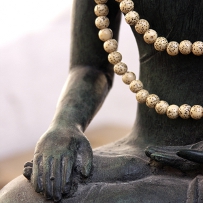
As a monk, I bring a strong commitment, along with the renunciate flavor, to the classic Buddhist teachings. I play with ideas, with humor and a current way of expressing the teachings, but I don't dilute them.
Sitting in a field of fifty to eighty people really starts my mind sparking. Since I don't prepare my talks ahead of time, I find myself listening to what I'm saying along with everyone else. This leaves a lot of room for the Dhamma to come up. Just having eighty people listening to me is enough to engage me, stimulate me, and create a nice flow of energy. The actual process of teaching evokes ideas that even I did not realize were being held somewhere in my mind.
Different teaching situations offer their own unique value. In retreat, you are able to build a cohesive and comprehensive body of the teachings. When people are not on retreat and come for one session, it opens a different window. They are more spontaneous and I'm given the chance to contact them in ways that are closer to their "daily-life mind." This brings up surprises and interesting opportunities for me to learn even more.
I'm continually struck by how important it is to establish a foundation of morality, commitment, and a sense of personal values for the Vipassana teachings to rest upon. Personal values have to be more than ideas. They have to actually work for us, to be genuinely felt in our lives. We can't bluff our way into insight. The investigative path is an intimate experience that empowers our individuality in a way that is not egocentric. Vipassana encourages transpersonal individuality rather than ego enhancement. It allow for a spacious authenticity to replace a defended personality.
I normally incorporate Qi Gong instruction in my retreats. They are not suitable as audio files but you can watch the nine videos here: https://tinyurl.com/Sucitto-qigong
Questions précised - 00:16 Q1 Is it possible to start waking up and still have a mind that is clinging or fixating at times? What are the characteristics of awakening? 14:27 Q2 Sometimes there are moments where everything is gone or stops, with no thoughts or awareness f an outside world. Time seems to be gone as well. Can you say something about this?16:21 Q3 It seems the heart needs to be allowed to know itself. When with family and partner there seems to be no possibility for this. This is desperately uncomfortable which doesn’t resolve and is filled with fear. Can you offer some guidance. 22:54 Q4(a) I feel parts of the body frozen in anxiety. Spacious awareness and reclining help. What else would help? Patience? (b) I get feelings of joy, gratitude then contentment. When contentment arises I feel the desire to move on rather than stay with it. What can I do about this? (c) What can I do if the energy flow gets overwhelming say with sickness? 34:46 Q5 What would you say to a teenager who seems to have ill will in the family? 36:44 Q6 No matter how good meditation is in the previous evening, there will come sleep and with it the end of awareness. Next morning we have to start again.
Questions précised - 00:06 Q1 A lot is said about ‘moving away from’. Could you also say something about moving towards? 15:31 Q2 When I have pain while sitting I usually practice with the pain until I feel there may be a risk to my health, for example by restricting blood flow in the leg for too long. Any ideas on this please? 17:23 Q3 Regarding sleepiness while witting, I discovered that by surrendering to it my body deeply rests and then the mind is bright again. Any comments please? 21:52 Q4 Meditation doesn’t allow me to gather energy but actually dissipates it. Why does this happen? 30:53 Q5 I live in a country where’s there’s a lot of suffering and misery and this often throws me into a state between empathy and impotence. What can you advise please? Q6 34:40 I live in the midst of great fear, witnessing emotional hostility. Where do actions and decisions and wise reflection play a part in helping but if I do too much the thinking mind goes astray. What is your advice please? 37:31 Q7 How does one we free oneself from jealousy and comparison? 40:12 Q8 How can we help others who are suffering but believe they are happy?
(Questions précised) - 00:32 Q1 Could you please explain what you mean by the cosmos? 16:16 Q2 When you say feeling”, do you mean vedena or more complex emotions? 20:32 Q3 How can one be with emotions and not in them? 33:33 Q4 Could you talk more about tanha and its relationship to sanya and dukkha. 44:21 Q5 In one of the guided meditations, you mentioned getting in touch with joy. How can we do that when it can feel completely absent.
Practicing composure, collectedness and stability enables us to be wise and compassionate towards forms that arise from both internal and external domains.